
strategy · engineering
Vibe coding is cheap. Winning still isn't
Is vibe coding the future? Yes, for the cheap part. Code was a real moat and AI is draining it. Here's the part it can't touch, the one that decides who wins.
By Pablo Gancharov

AI made it cheap to build almost anything. Some call it vibe coding: describe what you want, let the model write it, ship what comes out. A working prototype in an afternoon. A logo in a minute. A pitch deck before lunch. And the people using it are splitting into two groups, with the gap between them getting wider.
One group uses AI to produce more. More features, more prototypes, more side projects, more posts. Most of it never gets used by anyone.
Cheap doesn’t rescue that. A product nobody wants is a loss whether it cost $14K or almost nothing. The person who spent that time finding out what people actually wanted, instead of building another one, is already ahead of the one who shipped five.
The other group uses AI to reach the hard part faster. They skip the boilerplate, the setup, the first ugly draft, and spend the time they saved on the thing most likely to decide whether they win: contact with reality. (You can always catch up on the building itself later, and fast, the way we describe in our post on agentic delivery.)
I think which group you land in has less to do with how good you are with the tools than with whether you’re willing to sit in the discomfort.
The code was the moat
For a long time, code was a real moat. It was expensive, and it was hard. $14K for a week of work was a fair price, and being able to build the thing well, on time, without it collapsing later, was a genuine edge. Whole companies were built on that edge. Ours is one of them. Nothing wrong with that. It was fine.
AI drained a lot of it. A working prototype now lands in a day where 2 years ago it took a month and a budget. Some technical PMs have stopped writing Jira epics and now write the spec that drives an agent instead, for about the same effort, and working code comes out the other end. The gap that used to sit between you and the person who couldn’t build is a lot cheaper to cross now.
But it was only ever a barrier to entry. It kept other people out. It never made customers show up. Plenty of beautifully built things died anyway, and plenty of fast, imperfect ones won. Reid Hoffman’s line still holds: if you aren’t embarrassed by the first version of your product, you shipped too late.
So when the moat drains, what’s left standing is the part that was quietly doing the deciding all along: the slow, human work of finding out whether anyone actually wants the thing. That part didn’t get cheaper.
Worth sitting with, if “I can build it” was all you had.
Measure twice, cut once
Carpenters say measure twice, cut once. The saying only works because a wrong cut is an expensive mistake. The wood cost real money, and you can’t un-cut it, so a ruined board comes straight out of your pocket. You put your care into the measuring up front, because that’s where mistakes are still cheap.
AI changed the arithmetic. Generating the code costs almost nothing now, and neither does trying another approach. You can throw ten solutions at a problem before lunch and start fresh every time.
When a wrong cut stops costing anything, the reason to measure goes with it. Why line it up carefully when a bad one is free? So people cut all day, build, build, build, and never measure against the only thing that still matters: whether anyone wanted the shelf.
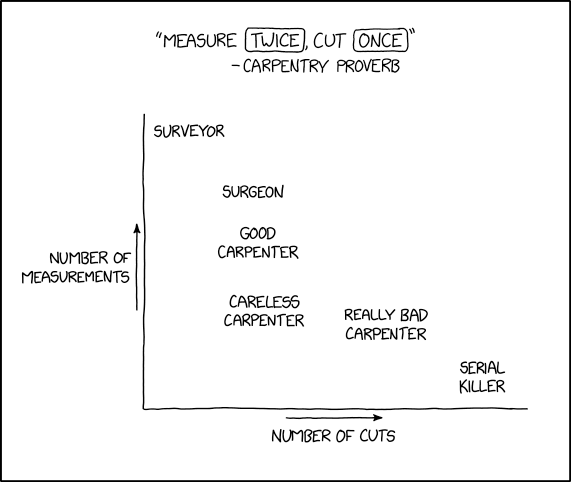
There’s an xkcd that plots jobs by how much they measure against how much they cut. The best line is in the alt text, the enlightened carpenter who measures zero times and cuts zero times, having decided the wood is fine where it is. AI is good at enabling that version too, the one where you plan in your head for months, cut nothing, ship nothing, and call it thinking.
Some people are wiring the measuring back in on purpose. Part of Garry Tan’s open-source gstack is a set of skills that argue with your idea before you write a line of code, running the plan past a simulated CEO and a YC-style office hours. The intended deal is simple: if you can’t convince it the idea is worth building, don’t spend the tokens building it. Measure, then cut.
That’s a better way to hold the tool, and it still isn’t the whole job. An AI playing your toughest investor is a rehearsal. A useful one, but nobody’s money is on the table. Convincing gstack is cheaper than convincing a customer, and it counts for less.
Measuring was always the hard part. AI just made it easier to skip.
The trap for people who are good at building
If you’re a strong builder, AI hands you a comfortable place to hide.
You can keep building. Forever. New feature, new refactor, new repo, new landing page. It feels like work. It looks like progress. Your commit history is beautiful. And you rarely have to do the thing that actually moves you forward, which is put the work in front of someone who can say no.
AI makes that trap deeper. The resistance that used to stop you (this is taking too long, I’m tired, I can’t build all of this alone) is gone. You can now generate busywork faster than reality can correct you.
What AI didn’t touch
Write down the things that actually decide whether you make it. Then check which ones AI made easier.
- Taking a real risk with real downside.
- Putting your work in front of people who might reject it.
- Hearing “no” 10 times in a row and going back for the 11th.
- Keeping going when nobody believes the thing will work.
- Disappointing people, sometimes people you like.
- Watching peers pass you while you feel stuck.
AI didn’t make any of them much easier. They were the hard parts before, they’re the hard parts now, and I’d argue they were mostly the parts doing the actual sorting.
In our world that list has a technical shape. Shipping to real users instead of a demo. Passing a security review instead of assuming you will. Watching the thing fall over under real load and owning it. Telling a client the number is bigger than they hoped it would be. The vibe-coded prototype that looked finished on Friday is usually where the hard part begins.
The comfortable escape
The failure mode I’d watch for is quiet, because it feels great.
You sit with your AI, you describe the thing, it builds the thing, it tells you the thing is excellent. You feel productive. You feel backed. And you haven’t talked to a single person who could tell you the truth.
That loop can run for months. It scratches every itch real progress scratches, with none of the risk. It’s one of the most comfortable ways to go nowhere I’ve seen, and it’s available to anyone now for $20 a month.
So, is agentic coding the future?
Yes, mostly. Describing what you want and letting a model build it is here to stay, and it’ll keep getting cheaper and faster. It’s the future of the cheap part, the cutting. It leaves the expensive part exactly where it was: whether anyone wants the thing, whether it holds up in front of real users, whether it survives a security review instead of demoing well and falling over in production.
Who wins now
Probably the same people who tended to win before. The ones who keep dragging themselves back to reality even when it’s unpleasant. Who ship the thing and read the harsh feedback. Who hear no and keep their nerve.
AI is genuinely useful to them, because it clears the boring work so they reach the hard part sooner. For others it can quietly turn into a place to hide.
The tools got much better this year. The work underneath mostly didn’t. So go find out if you’re wrong, faster.