
engineering
Exploring T-Shaped Knowledge and LLMs in Software Engineering
Why T-shaped engineers, paired with LLMs, deliver better outcomes on AEC software projects. Cross-functional depth, hiring, and team dynamics.
By Lagarsoft Engineering

Learning to learn has become a leitmotif in every educational and business context, even more when talking about skills.
When thinking about the alpha generation, still at school, we need to remember that the number-one competition their learning is focused on is: learn to learn.
So, you might be wondering why this bee is in our bonnet. First it was all about soft-skills and hard-skills, last year’s main topic was upskilling and reskilling. What happens when you are a small-medium software dev-shop like Lagarsoft is that you become interested in a different word: crossfunction.
Some cool data
Studies have shown that software engineers with T-shaped knowledge are more effective in cross-functional teams, the kind we lean on for AEC software projects, able to bridge gaps between development, design, and operations.
For instance, engineers with skills in both coding and UX/UI design are 30% more likely to contribute to successful project outcomes, due to having a holistic perspective.
T-Shaped knowledge?
To bring it down to earth, T-shaped knowledge refers to a skill set where an individual has deep expertise in one specific area (the vertical bar of the “T”) while also possessing a broad understanding of related fields (the horizontal bar).
This combination allows them to collaborate effectively across disciplines while maintaining specialized knowledge.
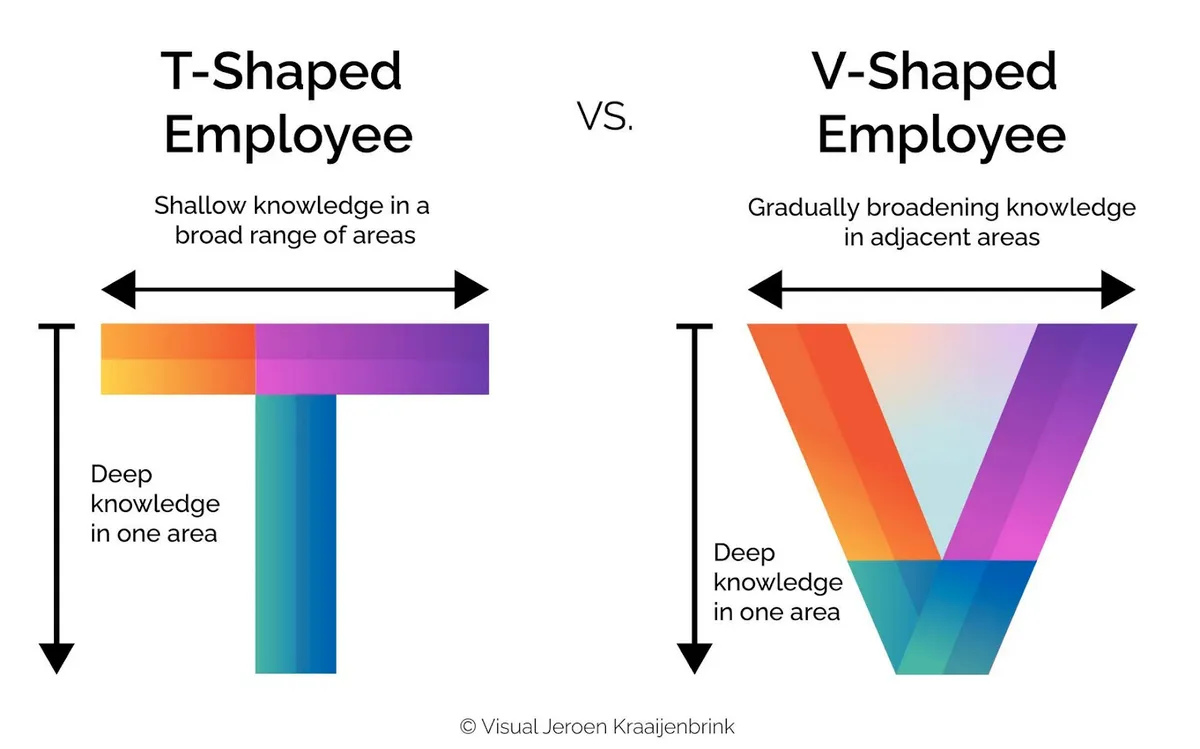
T-shaped knowledge, plus V, X and I
You can also explore the concepts of X-shaped and I-shaped knowledge. I-shape is a deep specialist with little cross-discipline reach. X-shape is a leader who can connect multiple specialties around a vision. V-shape compounds depth in one area with related-domain mastery.
LLMs are taking root
Recent surveys indicate that over 60% of software development teams are exploring or actively using LLMs to:
- automate code generation
- perform code reviews
- design system architectures
This integration has led to a 40% increase in productivity and a significant reduction in time-to-market for new features.
Fostering T-shaped knowledge becomes a priority so engineers know, learn, use and reflect on tools that boost productivity.
The cool thing is that you can diverge, and after doing so you can either become T-shaped or, if you keep on exploring that new area, you can become an X or even V-shaped knowledge worker.
Intersection with T-shaped Knowledge and LLMs
LLMs can help software engineers develop the horizontal part of the T. How?
They can quickly provide information and learning materials across various domains, aiding engineers in acquiring broad knowledge. Remember: sharing is caring.
They can also assist in deepening expertise in a specific area. For example, they can help engineers solve complex problems by providing advanced solutions and insights.
LLMs can improve communication and collaboration within teams by providing clear and concise explanations, generating documentation, and facilitating knowledge sharing.
Continuous learning and staying updated with the latest trends and technologies is a must at Lagarsoft, and it shapes how we approach every custom software engagement.